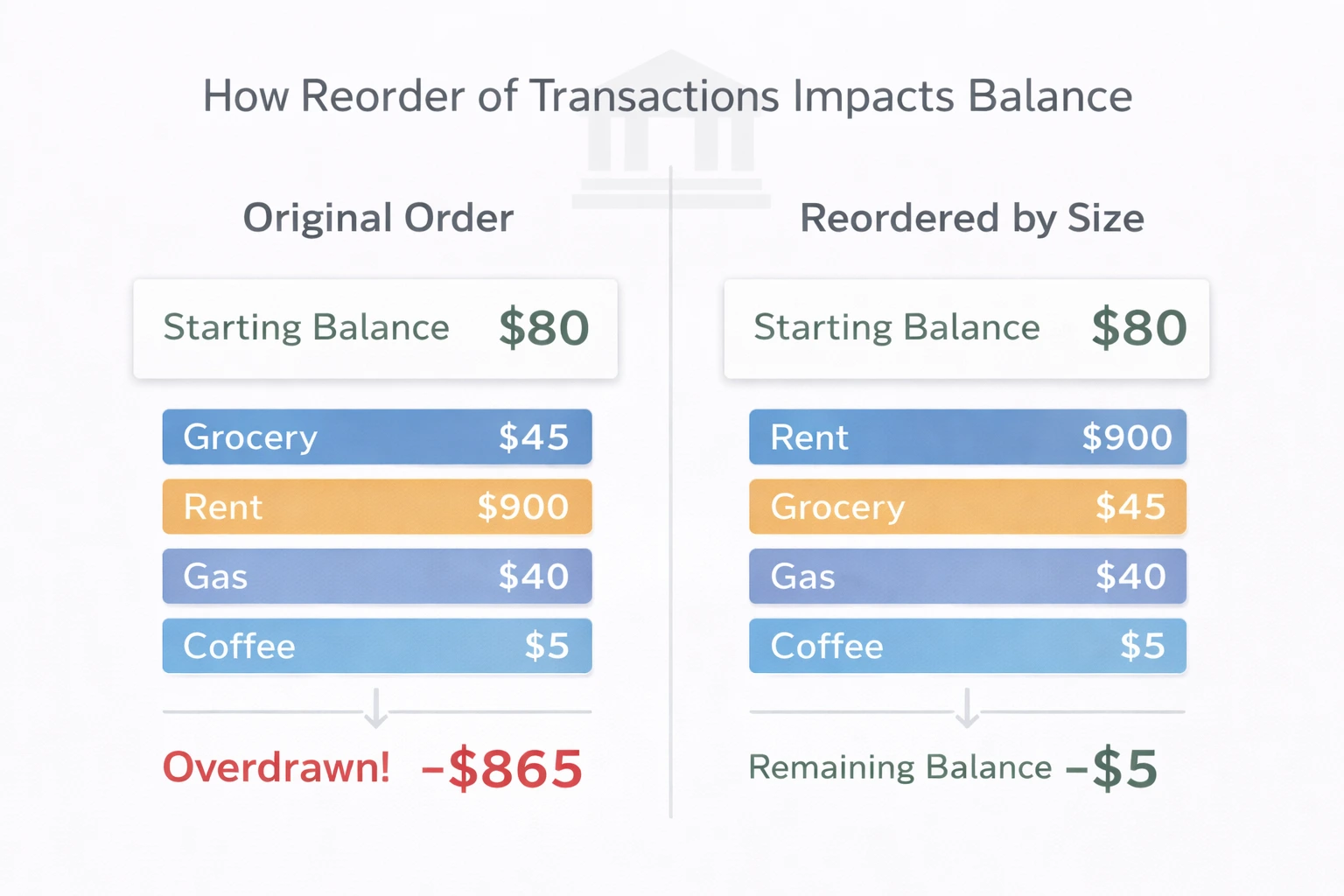
Quick answer: Banks reorder transactions because different payment types settle at different times — debit card purchases, ACH transfers, checks, and wire transfers all move through separate processing systems with different timelines. When multiple transactions arrive in the same posting batch, banks apply their own sequencing rules to determine which posts first. This affects your balance during the posting period and, in overdraft situations, can determine which transactions clear and which are declined or returned.
Why transaction order matters
Most of the time, transaction order is invisible — your balance reflects everything correctly and you never think about the sequence. Order becomes important in two situations: when your balance is low enough that the sequence affects whether transactions clear, and when you are trying to understand why your balance looks different from what you expected based on your own mental accounting.
If your available balance is $200 and three transactions post in the same batch — a $50 debit card purchase, a $100 ACH transfer out, and a $175 check — the order in which they post determines whether all three clear or whether one or more triggers an overdraft fee. Post the check last and it might clear fine. Post it first and the remaining balance may be insufficient for one of the other transactions.
Why banks do not always post transactions in the order they happened
The banking system does not process all payment types in real time. Different transaction types move through different networks — the ACH network, the card networks, the Federal Reserve’s wire system, the check clearing system — each with their own settlement cycles and batch windows. When multiple transactions from different networks arrive at your bank in the same processing cycle, the bank has to decide how to sequence them for posting. There is no universal rule — each bank applies its own posting order policy.
The result is that a debit card purchase you made on Tuesday afternoon might post at the same time as a check you wrote on Monday — and depending on your bank’s sequencing policy, either one might post first.
How different transaction types are sequenced
Debit card purchases
Debit card purchases have two stages. At the point of sale, the bank places an authorization hold — the amount is deducted from your available balance immediately, but the transaction has not posted yet. The actual posting happens when the merchant submits its batch, typically one to three business days after the purchase. This means your available balance reflects the purchase right away, but your current (or ledger) balance does not update until posting.
When multiple debit card settlements arrive in the same batch, banks typically post them in chronological order based on the authorization time — which is close to the actual purchase time. Some banks post the highest amounts first, or use a hybrid approach. Check your bank’s account agreement for its specific policy.
ACH transfers
ACH transactions — direct deposits, bill payments, external transfers — are processed in batches through the Federal Reserve’s ACH network on business days. Files are submitted at specific windows during the day and settle in the next available processing cycle. ACH transactions that arrive together in the same batch are typically posted in the order they appear in the file — which reflects when the originator submitted them, not necessarily the time you authorized them.
Checks
Checks clear through the check clearing system and typically post overnight after the receiving bank processes them. When multiple checks arrive in the same processing run, most banks post them in check number order — lowest to highest. This is a deliberate holdover from an era when consumers would write checks sequentially and expect earlier-numbered checks to clear first. Some banks post checks from highest to lowest amount, which was a common and controversial practice that resulted in regulatory scrutiny.
How banks sequence across transaction types
When multiple transaction types arrive in the same posting cycle, most banks post them in a set order: credits (deposits and incoming transfers) are posted first, then debits are posted in a bank-specific sequence. Credits posting before debits helps ensure incoming funds are available before outgoing transactions are deducted — which generally works in the account holder’s favor.
The sequencing of debits across transaction types is where banks have the most discretion and where the most variation exists. Some banks post debit card transactions before checks; others post checks first. The specific order is disclosed in each bank’s account agreement — the document most people never read but that governs exactly these situations.
Why posting order sometimes looks wrong to you
Your mental model of transaction order is based on when you did things. The bank’s posting order is based on when each payment type settled through its respective network. These two timelines rarely match exactly, which produces situations that feel wrong even though the bank is following its stated policy.
The most common examples:
- A check you wrote last week posts the same day as a debit card purchase you made yesterday — because the check just cleared the check network today
- A large debit posts before several small ones, even though you made the small purchases first — because your bank posts debits highest-to-lowest within the same batch
- A deposit you made at 4:00 PM does not affect whether a check clears that night — because the deposit arrived after the bank’s deposit cutoff for that business day’s processing cycle
- Your available balance showed sufficient funds when you made a purchase, but you still got an overdraft — because another transaction arrived and posted first in the same batch
The regulatory history of transaction reordering
Transaction reordering — particularly posting debits from highest to lowest amount — became a major regulatory issue in the 2010s. The highest-to-lowest practice maximized overdraft fees by ensuring the largest transaction depleted the account first, leaving the remaining smaller transactions more likely to cause individual overdrafts. Banks earned significantly more in overdraft fees per customer using this approach than they did with chronological posting.
Several major banks faced class action lawsuits and regulatory actions over the practice. Wells Fargo paid $203 million in 2010 to settle a California class action. Bank of America paid $410 million in a similar 2011 settlement. Following these actions and increased Consumer Financial Protection Bureau scrutiny, most major banks moved away from highest-to-lowest posting for debit card transactions — though the practice was not universally prohibited. Most banks now use chronological or low-to-high ordering for debit card transactions, or a hybrid of transaction type categories posted in a disclosed sequence.
What you can do about transaction posting order
Read your bank’s posting order policy
Your bank is required to disclose its transaction posting order in its account agreement and deposit account terms. The specific document may be called a Deposit Account Agreement, Consumer Deposit Agreement, or Terms and Conditions. Most major banks also publish their posting order policy on their website. Reading it once is enough to understand how your bank sequences transactions — it rarely changes.
Monitor your available balance, not your current balance
Your available balance is a more accurate picture of what you can safely spend than your current (ledger) balance. The available balance deducts pending debit card authorizations and deposit holds that have not yet posted — giving you a closer-to-real-time view of what the bank considers accessible. Spending based on the current balance without accounting for pending transactions is one of the most common causes of unexpected overdrafts.
Time deposits strategically
Deposits made before your bank’s cutoff time on a business day are credited and available for the same day’s posting cycle. Deposits made after the cutoff — typically 5:00 PM to 9:00 PM depending on the bank and deposit method — are credited the next business day. If you are making a deposit to cover pending transactions, timing it before the cutoff ensures it posts before the outgoing transactions are sequenced in that night’s batch.
Set up account alerts
Most banks offer low-balance alerts that notify you when your available balance drops below a threshold you set. These alerts give you time to make a deposit or transfer before that night’s posting cycle processes — which is the moment transaction order actually matters. A low-balance alert at $50 gives you the remainder of the business day to act.
Opt out of debit card overdraft coverage if you prefer declines over fees
Under Regulation E, banks must obtain your affirmative consent before enrolling you in overdraft coverage for debit card and ATM transactions. If you have opted into overdraft coverage, debit card transactions that exceed your balance will be approved — and you will be charged an overdraft fee. If you have not opted in, the transaction will be declined at the point of sale — no fee, no overdraft. Opting out of overdraft coverage eliminates overdraft fees on debit card transactions entirely, at the cost of the occasional decline. Contact your bank to check your current overdraft enrollment status.
Related guides
- Available balance vs current balance explained
- Why bank transactions go pending
- How long bank transfers take
- How bank holds work
- Why banking is not instant
Frequently Asked Questions
Why do banks reorder transactions?
Different payment types — debit cards, ACH, checks, wires — settle through different networks at different times. When multiple transactions from different networks arrive in the same posting batch, banks apply their own sequencing rules to determine posting order. This is not random — it is disclosed in each bank’s account agreement. The most common approach is to post credits first, then sequence debits by transaction type and either chronological order, check number order, or in some cases amount order.
Do banks still post highest transactions first?
Most major banks moved away from highest-to-lowest posting for debit card transactions following regulatory scrutiny and class action settlements in the 2010s. However, not all banks abandoned the practice entirely, and it is still permitted in some contexts. Your bank’s current posting order policy is disclosed in its deposit account agreement — it is worth checking if you have concerns about how your bank sequences transactions.
Why did I get an overdraft fee when I had enough money?
The most common explanations are: your available balance — not your current balance — was insufficient because pending transactions had already reduced it before the posting cycle ran; a deposit you made arrived after the bank’s cutoff time and did not post until the next business day; or multiple transactions posted in the same batch and one posted before a deposit could cover the others. Monitoring your available balance rather than your current balance gives you a more accurate picture of what the bank will actually let clear.
In what order do banks post transactions?
Most banks follow a general framework: credits post before debits, then debits are sequenced by transaction type. Within each type, debit card transactions are typically posted chronologically by authorization time, checks are typically posted in check number order or chronologically, and ACH transactions post in file order. The exact policy varies by bank and is disclosed in the account agreement.
Can I change the order my bank posts transactions?
No — you cannot change your bank’s posting order policy. What you can control is the timing of your deposits and transactions to work within the system: deposit before the bank’s cutoff time to ensure credits post before debits in the same cycle, monitor your available balance rather than your current balance, and set up low-balance alerts to give yourself time to act before the nightly posting cycle runs.
Does transaction posting order affect overdraft fees?
Yes, directly. If multiple transactions post in the same batch and your balance is insufficient to cover all of them, the posting order determines which transactions clear and which trigger overdraft fees. A bank that posts the largest transaction first will exhaust the balance sooner, leaving more transactions to trigger individual overdraft fees. A bank that posts chronologically or lowest-to-highest will maximize the number of smaller transactions that clear before the balance is depleted. This is why posting order has historically been the subject of regulatory action and consumer litigation.
